

From Scrolls to Attendance

Why museums need more than just social media marketing
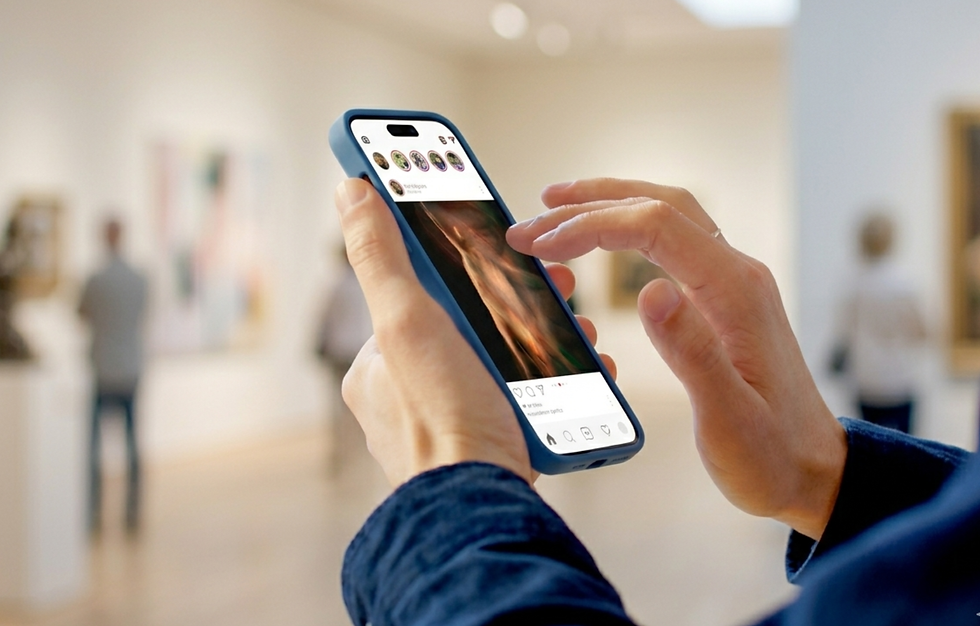
Are your Instagram ads actually bringing visitors into your museum - or mostly generating impressions in someone else’s feed?
Across Europe, museums work with limited marketing resources. In many institutions, marketing represents less than 10% of overall budgets. Within that, paid social media campaigns often receive only a small share. When promotion budgets per exhibition are limited, every marketing decision matters.
The question is no longer how many people see your exhibition announcement. The question is how many people decide to visit.
Awareness is not the same as attendance
Platforms like Instagram play an important role in museum communication. They are excellent tools for storytelling, community building, and visibility. But social media advertising follows a different logic than planning a visit.
Users encounter exhibition announcements while scrolling through content primarily designed for inspiration and distraction. Even when posts are saved or liked, they often remain one moment among many others in a crowded feed.
Visibility creates awareness.
Attendance requires intention.
This difference becomes increasingly relevant as marketing budgets tighten and institutions look more closely at measurable outcomes.
Interruption vs intent-based discovery
Social media campaigns reach people who might be interested in art. Intent-based discovery platforms reach people who are already planning cultural activities. This is a crucial distinction.
A visitor who encounters an exhibition while browsing social media may appreciate the content but postpone the decision. A visitor actively searching for exhibitions happening this week is already much closer to attending.
Supporting audiences at this moment of decision-making is becoming an important second pillar of digital cultural marketing.
From impressions per euro to attendance per euro
Museum marketing has traditionally measured success through reach, impressions, and engagement. These indicators remain useful but they do not necessarily translate into visits.
Increasingly, institutions are beginning to look at another metric: attendance per euro.
The difference between awareness-based promotion and intent-based discovery becomes particularly visible when comparing typical campaign dynamics.
To illustrate this shift, the table below outlines a representative comparison between a €199 Instagram campaign and a €199 myCULTURE promotion:
Metric | Instagram ad | myCULTURE promotion |
Audience type | General social media users | People actively looking for exhibitions |
Targeting | Interest category: “art” | Specific art topics (e.g. contextual art, queer art), broader themes (e.g. spirituality, climate change), or visitor moods (e.g. bold & inspirational) |
Duration | 7-14 days | 3 months continuous visibility |
Typical clicks | approx. 400 | approx. 200-350 highly qualified clicks |
Visitor conversion | approx. 3-6% | approx. 15-30% |
Estimated exhibition visitors | approx. 12-24 | approx. 30-105 |
Discoverability effect | Stops when campaign ends | Continued discovery through event recommendations, artist connections, and thematic exploration |
Cost per visitor | approx. €8-€16 | approx. 2-€7 |
*These figures reflect typical campaign ranges based on comparable exhibition promotion scenarios and may vary depending on exhibition profile, timing, and audience targeting.
What this comparison highlights is not that one channel replaces another - but that different channels support different stages of the visitor journey.
Social media creates awareness.
Intent-based discovery supports decisions.
Supporting the moment when visits are planned
Today’s cultural audiences rarely decide spontaneously which exhibitions to attend. Instead, they plan their cultural activities across multiple digital touchpoints.
They search for exhibitions happening this week.
They explore artists connected to topics they care about.
They look for cultural experiences that fit their schedule and interests.
Platforms such as myCULTURE support this planning phase by making exhibitions discoverable within thematic contexts, artist networks, and recommendation pathways that extend beyond a single promotional moment.
Instead of appearing briefly in a scrolling feed, exhibitions remain visible across a longer decision window.
A complementary strategy for museum marketing
Social media will remain an essential communication channel for museums. It supports storytelling, visibility, and community engagement in ways that discovery platforms cannot replace.
At the same time, intent-based cultural discovery platforms are becoming a natural complement to these channels by reaching audiences at the moment they are actively planning visits.
Together, these approaches strengthen both visibility and attendance.
The key question for museum marketing today is therefore not whether visibility matters.
It is how visibility becomes visits.
Do you want people to see your event - or visit it?
Ready to bring more visitors to your exhibitions? Contact us for a free consultation at partners@myculture.app or fill in the following form and we will get back to you soon.


